URGENT – WEATHER MESSAGE National Weather Service Seattle WA 217 PM PDT Wed Jul 27 2022 WAZ503-504-506-511-512-281200-/O.EXT.KSEW.HT.Y.0002.000000T0000Z-220731T0400Z/
Western Whatcom County-Southwest Interior-Western Skagit County-Hood Canal Area-Lower Chehalis Valley Area-Including the cities of Bellingham, Olympia, Lacey, Tumwater, Mount Vernon, Anacortes, Sedro-Woolley, Burlington, Shelton, Montesano, Elma, and McCleary
217 PM PDT Wed Jul 27 2022 …HEAT ADVISORY NOW IN EFFECT UNTIL 9 PM PDT SATURDAY…
* WHAT…Hot conditions with temperatures in the 90s and low temperatures in the low to mid 60s. This will pose a moderate to high risk of heat-related illness.
* WHERE…Lower Chehalis Valley Area, Western Whatcom County, Hood Canal Area, Southwest Interior and Western Skagit County. * WHEN…Until 9 PM PDT Saturday. * IMPACTS…Heat will increase the risk of heat-related illnesses for those who are sensitive to heat, especially those without effective cooling or adequate hydration.
PRECAUTIONARY/PREPAREDNESS ACTIONS… Drink plenty of fluids, stay in an air-conditioned room, stay out of the sun, and check up on relatives and neighbors. Young children and pets should never be left unattended in vehicles under any circumstances. Take extra precautions if you work or spend time outside. When possible reschedule strenuous activities to early morning or evening. Know the signs and symptoms of heat exhaustion and heat stroke. Wear lightweight and loose fitting clothing when possible.
To reduce risk during outdoor work, the Occupational Safety and Health Administration recommends scheduling frequent rest breaks in shaded or air conditioned environments.
Anyone overcome by heat should be moved to a cool and shaded location. Heat stroke is an emergency! Call 9 1 1.
For sheltering information and other human services in your area, dial 2 1 1 during business hours or visit wa211.org anytime.
Posted inMeetings|Comments Off on Gonna Get A Bit Warm These Next Few Days. Again. Stay Inside If You Can!
I learned some valuable lessons yesterday as I sought to activate my first park through Parks On The Air, or POTA.
I gathered up my radio gear and headed out, not knowing whether I would actually make it to Potlatch State Park, get set up, and operate. I got my morning coffee and turned up the volume on my Kenwood D710G so I could monitor the N7SK repeater. I had just about convinced myself that the day would be just as nice if I took a quiet drive and consumed my coffee, but then had a conversation with Ben AB7I and mentioned my preparations for POTA.
Ben, of course, is an accomplished POTA operator. I described him to my spouse as the Yoda of POTA. It will probably suffice to say that Ben knows more about POTA than I likely ever will.
But back to the QSO with Ben. On the 2-meter repeater, we talked about POTA and where I would set up. I mentioned Potlatch State Park. It turns out that Ben has worked from that park many times. He offered to join me there in a bit to see if he could offer any helpful pointers and I readily accepted.
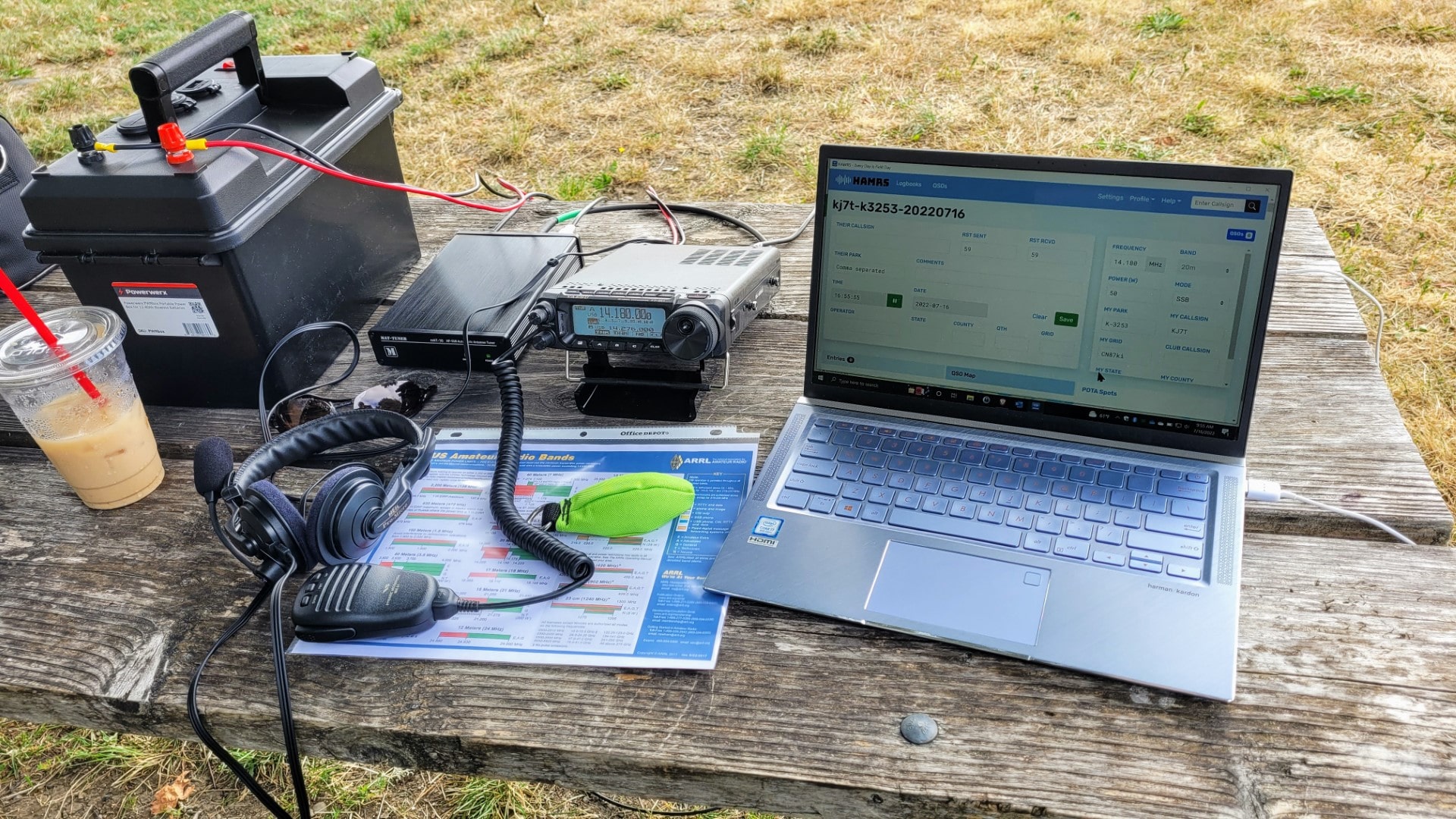
StationAntennaOperatorPOTA station at park K-3253
Location
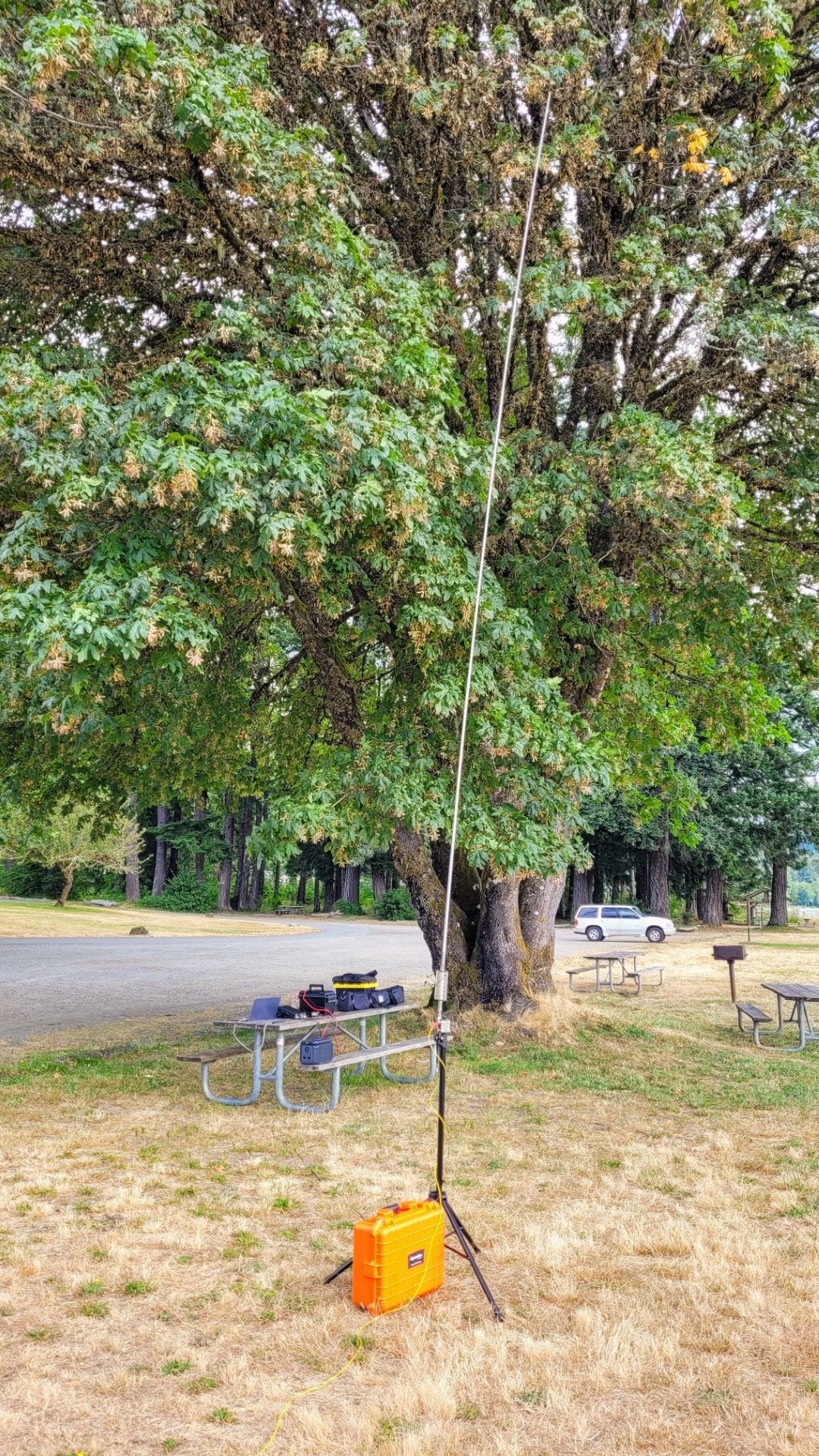
When I got to the park, I almost chose a spot away from the water. However, part of the enjoyment of POTA operations is enjoying the beauty of the landscape around you, so I chose to set up at a picnic table about 100 feet from the bank of Hood Canal and next to an old big-leaf maple tree. The sun was out, the breeze was light, and there were very few people about.
Antenna
I really wanted to try my new Chameleon CHA LEFS end-fed sloper antenna. It is a very sleek, lightweight wire antenna that promised no-tune capability for the bands I’m most interested in. I tied a shot bag to some light line and flung it over a branch about 20 feet in the air.
After I got the dark olive-green wire stretched from the tree down to the ground, people started to show up. A few fellows with a kayak tried to walk right through the wire…twice. An older couple jogged by and the man suddenly turned and headed for the wire. Clearly, the wire was in the way and not easily detected, making the situation unsafe. I grumbled a bit to myself as I took the LEFS down and packed it away. I’ll use it another time when I can assure the safety of others.
My backup antenna was an MFJ Big Stick on a tripod. This is a base coil with a telescoping vertical antenna on top. I wasn’t really expecting much performance from it but it was a better choice with lots of people around than the wire antenna.
Radio and tuner
Now that the antenna was up, I turned my attention to the radio and tuner. I was using a Yaesu FT-891 and planned to operate mainly on 40 and 20 meters. With the no-tune wire, I had no real need for an antenna tuner. But with the Big Stick vertical antenna, I knew the tuner would be helpful.
I did not spend big bucks on the Yaesu antenna tuner recommended by Yaesu. Instead, I bought a mAT-30 antenna tuner off eBay. I had tested it at home and it tuned mismatches very quickly.
When I turned on the radio, it was still set for the last 40-meter frequency I had been on. A clear voice with plenty of volume was coming through the speaker. At least as a receive antenna, the vertical was working just fine!
Contacts
I ended up making 12 contacts before band conditions deteriorated. I had conversations with other radio operators in Washington, Idaho, California, Nevada, Utah, South Dakota, Michigan, Texas, and Alberta (Canada). One contact knew exactly where Potlatch State Park was because he was responding to my CQ call from Belfair, Washington.
Most folks responded as if this was a relaxed contest. In other words, they weren’t pushing to exchange signal reports and move on to the next contact. A few wanted to chat. I did not get that sense of pressure one can feel in a big contest. I don’t like that kind of feeling which is why I don’t generally participate in contests. POTA operating felt…nice.
Logging
I used HAMRS to log my POTA contacts. Ben AB7I had some great tips about logging and the later processing of POTA logs. I had been looking for that kind of information but the most current content I found was out of date, so Ben’s help was invaluable.
When I got home, I cleaned up the log and submitted it. It was processed and accepted in just a few minutes. After my first day of POTA operating, I even got the “Support Your Parks Activator” award.
Was it fun/useful?
I had a great time. Of course, I fumbled around a bit getting the hardware all set up, and then I fumbled around some more with the first several contacts. We’ve all done that and I’ve found that the amateur radio community is pretty forgiving when they realize you are just trying something for the first time.
As the morning warmed up, the number of park visitors increased. Several people stopped to talk, wondering what I was doing. One very young boy and his mom stopped to “see my drone.” When I asked why they thought I had a drone, the mom explained, “because you have a tall antenna!” The young fellow was tremendously disappointed when I said I was talking on a radio, not flying a drone.
There is some emergency communications utility in POTA. Moving a completely portable station, setting up efficiently and safely, and then making contact with people in several states is clearly a rehearsal for a more emergent situation. I was pleased with how smoothly my station setup went.
Will I do it again? Absolutely yes. It would be fun to do this with more than one operator, either using one station or operating dual stations. As you’ll read in item #3 below, having another operator present could be very useful, too!
Lessons learned
If possible, visit the park first to scope out where I might prefer to set up the station. That would have saved time.
Remember to remember safety. I had not thought about it as I prepared my gear for the POTA setup. Thus, I had no bright flagging to help people see the wire antenna angling down to the ground from the tree. I was glad, though, that I did pack a backup antenna.
Think about the bathroom before I get set up. Once your station is out where passersby can see it, it takes more faith than I have to walk away from the station to use the bathroom. A big reason I shut down (besides all the people and the deteriorating band conditions) was to take a “bio break.”
Consolidate my gear. I had a lot of redundancies. For example, why bring one coaxial cable when two would be better? I had doubles for many parts of the station. I can leave those in the car.
I’ll consider a three-ring binder or a clipboard with document storage. My band plan sheet was held down with my shot bag. I did have a composition book and a pen for manually logging contacts in case my computer didn’t work, but it would work better if I could contain those items in one place and have a good writing surface available.
I send out a big thank you to Ben AB7I for coming out to help me successfully launch my first park activation. I became interested in POTA a few years ago but put off doing anything because I didn’t know anyone doing it. A few months ago at the MCARC club meeting, Ben talked about his experiences with POTA operating. That was the catalyst I needed to get started. Thank you, Ben!
David Brooks, N7HT, will be teaching a General License Class starting on Tuesday, April 26, 2022, from 7 to 9 pm at the Department of Emergency Management Office located 100 Public Works Drive, Shelton, WA. 98584. The class will be ten ( 10) weeks in length.
If you are interested in learning and getting your General Class License, then this is the class that you will want to take. Those that have taken classes from Mr. Brooks for license upgrades have scored 90 % or better on the exam.
Please register with Dave Brooks, N7HT, at dbbrooks@hotmail.com or call 253.363.1692. This will provide Mr. Brooks with the information he needs to best deliver the course to those who are interested.
Thank you for your interest in Ham Radio and this class.
URGENT - WINTER WEATHER MESSAGE National Weather Service Seattle WA 423 PM PDT Sun Apr 10 2022 WAZ511-111200- /O.CON.KSEW.WW.Y.0018.220411T0700Z-220411T1800Z/

Hood Canal Area-including Shelton, Seabeck, Belfair, and Brinnon

423 PM PDT Sun Apr 10 2022
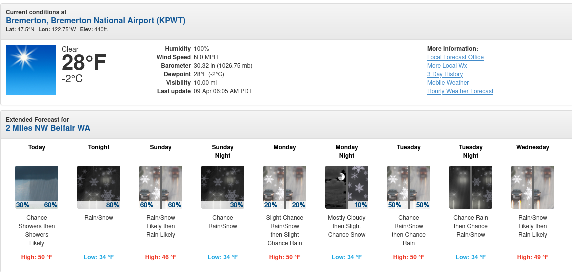
...WINTER WEATHER ADVISORY REMAINS IN EFFECT FROM MIDNIGHT TONIGHT (4 Apr) TO 11 AM PDT MONDAY...
* WHAT...Snow expected. Total snow accumulations of 1 to 2 inches.
* WHERE...Western Kitsap and the lowlands of eastern Jefferson and Mason Counties, including Brinnon, Seabeck, and Shelton.
* WHEN...From midnight tonight to 11 AM PDT Monday.
* IMPACTS...Plan on slippery road conditions.

PRECAUTIONARY/PREPAREDNESS ACTIONS... Slow down and use caution while traveling.

For the latest road conditions in Washington state, call 5 1 1.
Posted inMeetings|Comments Off on Winter Wx Advisory
Very heavy rain and flooding will be arriving on Monday, the result of a potent atmospheric river. Some locations in the lowlands will receive 2-4 inches on Monday, with twice that in “favored” mountain locations.
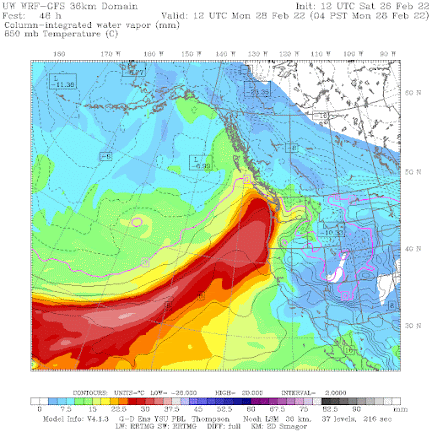
The origin of our wet future is a strong atmospheric river, a narrow region of large amounts of moisture, originating in the subtropics. To illustrate, below is a plot of total moisture from the surface to the top of the atmosphere at 4 AM Monday. As you might guess, the reddish colors are the largest amounts.
This atmospheric river starts north of Hawaii and heads northeastward right into our region. And when that river of moisture is forced upward by our regional terrain, an amazing amount of precipitation will be released. 2-3 inches over Puget Sound and as much as 7-10 inches in the mountains. Profound rain shadow from Sequim to northern Whidbey Island.
So (back to me) hang on to your buttocks we’re gonna get wet. Could be some wind with all that so make sure your antenna(s) are secured.
Suppose I *could* do a Lieutenant Dan in the storm from the top of my tower …
Posted inMeetings|Comments Off on Really, Really Wet Wx Moving In Over The Next Few Days
Beginning in February 2025, the Mason County Amateur Radio Club meets on the third Satuday of the month at the Mason County Department of Emergency Management (DEM) at 100 W Public Works Drive, Shelton, WA 98584. SEE THE MAP BELOW!
Net Reminder:
We still have our Chat Nets every Sunday evening @ 1900 hours (7:00 PM) on 146.72 MHz (- 103.5) and our 10-meter net on Tuesdays @ 1930 hours (7:30 PM) on 28.450 MHz (USB).
NMARES (The North Club) has a net on their new repeater every Monday at 1930 on 145.170 MHz with a negative 0.600 MHz offset (144.57 MHz) and a tone of 103.5.
You do not have to be a member of the club to join in! New folks are always welcome!
Take The Test!
VE exams for all license levels are offered the first Saturday of each month at 1100 (11 A.M.) at the Mason County Department of Emergency Management (DEM) at 100 W Public Works Drive, Shelton, WA 98584. For testing you will need the original and a copy of your present license (if you have your ticket already), some form of ID with YOUR picture on it, and $15.



 MC-ARC